

Guest Article By Cheshire & Wain's Resident Historian Kathryn Hughes
The sorrow felt over the loss of a cherished cat is a feeling that has transcended centuries. For historical figures, from the poet Edward Lear to novelist Thomas Hardy, this grief has manifested in extraordinary, sometimes controversial, acts of remembrance. Here, Cheshire & Wain’s resident historian Kathryn Hughes, explores a tradition spanning from stately aristocratic memorials and cemeteries to poetic tributes and Victorian taxidermy, delving into the enduring, elaborate and heartfelt ways people have memorialised their beloved feline companions despite sometimes facing public mockery and religious scorn.
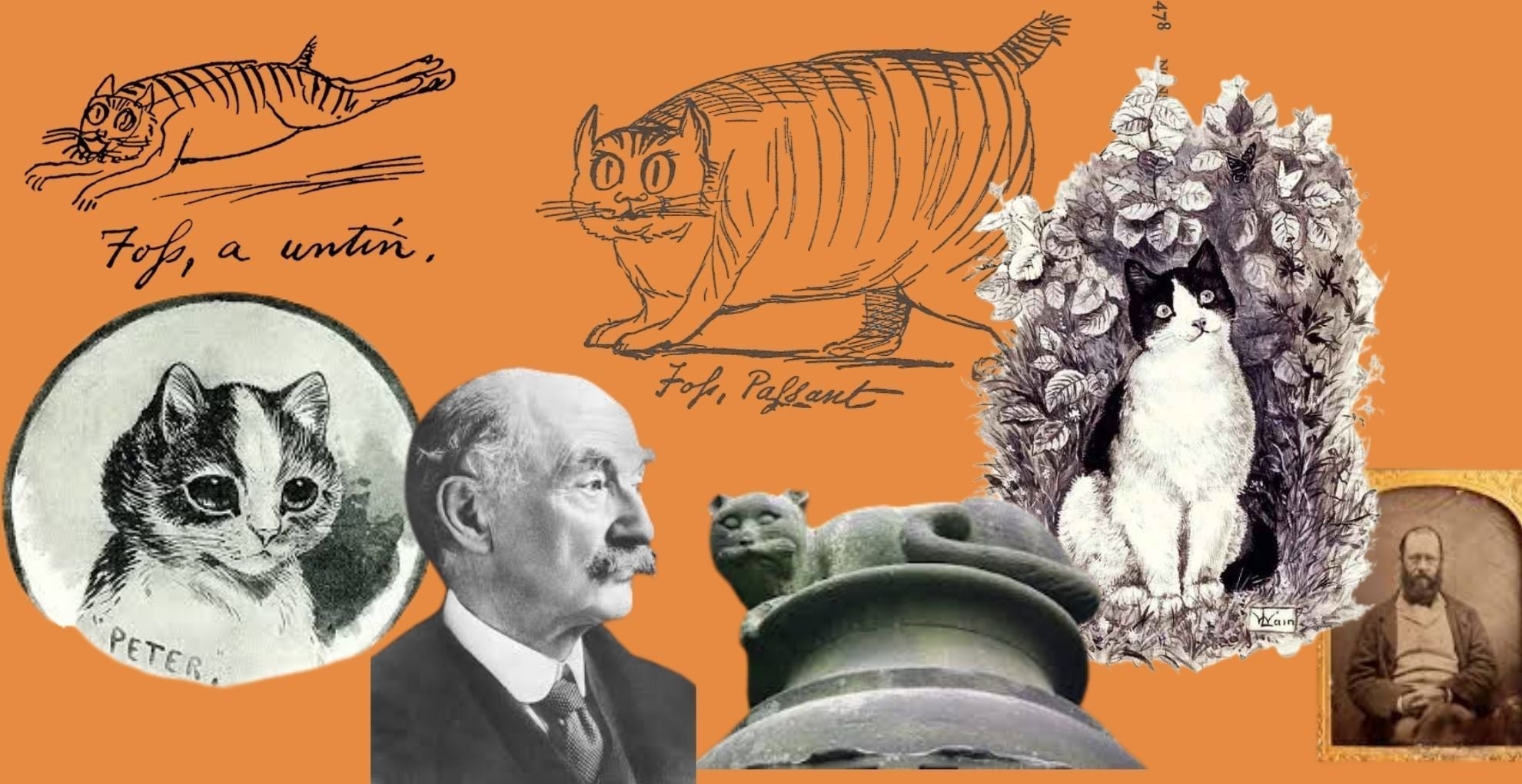
'My poor friend Foss … all those friends who have known my life will understand that I grieve over this loss.’ So wrote Edward Lear, the ‘nonsense’ poet, in 1887 on the death of his beloved cat. A lifelong bachelor, Lear had relied on his portly, stumpy tabby for 17 years of devoted partnership.

Lear outlived Foss by only a few months, quite possibly dying from a broken heart. He did, though, last long enough to ensure that his beloved friend was buried under a favourite fig tree in the garden of the Italian villa which they shared. The tombstone reads ‘Beneath lies buried my good cat Foss, he was in my house for 30 years and died on 26th July 1881. He is 31 years old’. This, of course, is a wild exaggeration. But so great was Lear’s sense of loss that it felt as though he was saying goodbye to a lifetime of love.
Lear’s circle, which included the poet Alfred Tennyson and his wife, would not have dreamt of making fun of their friend for burying Foss with such ceremony. They knew how much the portly tabby had meant to him. Other Victorians were not so lucky. Newspapers were quick to mock anyone, especially older single women, who invested too much time, trouble and cash in giving their cat a proper send-off. In the 1840s there were multiple reports of a Kensington lady ‘of distinction’ who commissioned a ‘fine oak coffin’ for her beloved seventeen-year-old cat, Paul. The handsome box was displayed with a wreath in the window of the local undertakers’ shop, ‘where it was an object of intense interest and not a little amusement’.
Being an aristocrat offered some protection from public scorn. Lady Marcus Beresford, who ran the high society ‘Cat Club’ in the 1890s, maintained a cemetery on the estate where she bred prize-winning Siamese. Tucked away under the trees was a series of stately white tombstones inscribed with the names of her departed felines. Lady Marcus was drawing here on a long tradition of aristocratic families who had for centuries buried their dogs, horses and even their cats on their estates, complete with handsome grave markers.
 At Shugborough Hall in Staffordshire, there is a magnificent ‘cat monument’, consisting of a handsome stone pedestal topped by a proud feline, built in 1749 to commemorate favourite Persian cat named 'Kouli-Khan' belonging to the owner, Thomas Anson.
In July 1922 the novelist E M Forster was staying with Thomas Hardy at Max Gate from where he wrote a newsy letter home to his mother. He reported how the Grand Old Man of Literature had taken him out to see the graves of all the Max Gate cats, complete with the headstones he had carefully carved himself. 'Snowbell’, ‘Pella’ and ‘Kitkin’ had all cruelly perished on the nearby railway line.
Hardy didn’t confine himself to carving beautiful headstones for his beloved cats. In 1904 he composed ‘Last Words to a Dumb Friend’, a much anthologised tribute to his beloved ‘Snowdove’, who had also fallen victim to the deadly railway line. In the poem, Hardy traces with melancholy fondness, the ways in which the departed feline would curl up on a chair or climb a pine tree at dusk. At one point he bursts out with that declaration familiar to every bereaved cat parent: ‘Never another pet for me!’ (of course, he changed his mind).
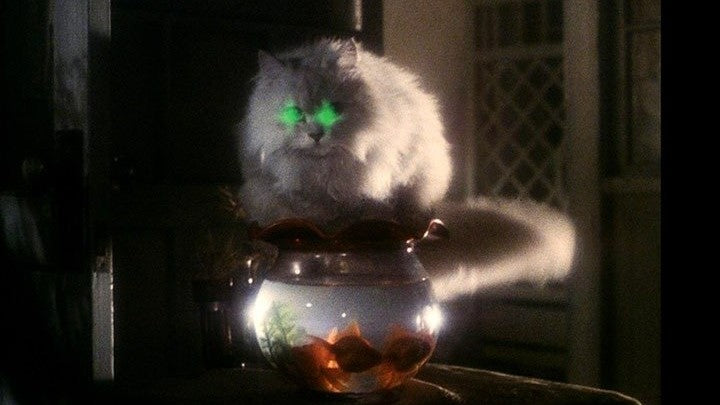
 In writing a poetic In Memoriam to Snowdove, Hardy was drawing on a distinguished tradition. In 1748 Thomas Gray had published ‘Ode on the Death of a Favourite Cat’ for his friend, the aesthete Horace Walpole. Walpole’s tabby, Selima, had drowned after falling into a large blue and white porcelain bowl while attempting to catch the goldfish. Walpole was heartbroken, but Gray chooses to treat the whole incident with a certain light-heartedness. In mock-heroic style, he sets out the story of ‘the hapless nymph’ (Selima) who is much admired for her ‘velvety paws’ and ‘emerald eyes’. The poem concludes with the famous cautionary line: ‘Nor all that glisters, gold’. Walpole loved the poem so much that he had the first stanza engraved on the pedestal of the goldfish tub as a tribute to poor Selima. You can see the bowl today at Strawberry Villa, Walpole’s exquisite Thames-side home.
 Treating your cat’s death with the reverence you might extend to a distinguished great aunt did not always go down well. Newspapers in the nineteenth century frequently featured outraged reports of single women who had managed to inveigle a vicar into giving their pet a Christian burial. The objection was not so much to do with taste as blasphemy. The Church was adamant that animals did not have souls, and so to involve them in religious rites smacked of a kind of devil worship.
The famous cat illustrator Louis Wain was surprisingly adamant on this point too. When his beloved cat ‘Peter’ passed away, Wain shared with his many followers how the fifteen-year-old tuxedo ‘died in my hands, a boy kitten again, talking and answering me as of old’.
 To the many fans who wrote asking whether he thought that cats had a soul and an afterlife, Wain was more cautious. As a practising Catholic, he felt obliged to tell them that he didn’t think there was any chance of meeting Peter in the Hereafter. Instead, he continued to use the many sketches he had made of his favourite feline to go on producing his inimitable art for the next forty years.
When it came to material remains, though, the Victorians were far less squeamish. In 1902 there was a report of one lady who had a small rug made out of her large Siamese cat (to be fair, she said afterwards that she wished she hadn’t). Charles Dickens, meanwhile, arranged for part of his deceased tabby Bob to be incorporated into a letter opener. While the cutting blade was to be made of elephant ivory, the handle would consist of one of Bob’s plushy forepaws. The useful tool bore the legend: ‘C. D. In Memory of Bob. 1862.’ You can still see it today in New York’s Public Library.
 And then there is Crimean Tom who is to be found stuffed, lumpily, in the National Army Museum. He was a brownish tabby, adopted by Lieutenant William Gair in Sebastopol after a year-long siege. Like a cat out of a fairy-tale, Tom led British forces to valuable caches of hidden supplies, rescuing them from starvation. Gair brought Tom back to England after the war, but the cat died soon afterwards. Wanting to preserve such an heroic feline, Gair arranged to have Tom stuffed and deposited him at the hugely prestigious Royal United Services Institute. You can see Tom today in the National Army Museum (although some sceptics suggest that he may not be the original, but a doppelganger).

It sounds gruesome, but to the pet-mad Victorians, having your cat stuffed and mounted was the best way of bringing your beloved friend back to life. It is, perhaps, the equivalent of today’s fashion for pet cloning. For about $50,000 you can obtain an exact copy of your deceased cat, using their DNA. The result is an animal that is genetically identical but, bewarned, its temperament and behaviour will not be a carbon of the original. That is because so much about personality, feline as well as human, is learned behaviour, a kind of chance. And who, honestly, would have it any other way?
CLICK HERE FOR MORE ARTICLES BY CHESHIRE & WAIN'S RESIDENT HISTORIAN

Share:
Introducing Our Latest Collection - Gold Label
The Feline as Muse: In Conversation with Ceramic Artist Susan Halls