

By: Sonja Farrell, Cheshire & Wain Founder & Creative Director
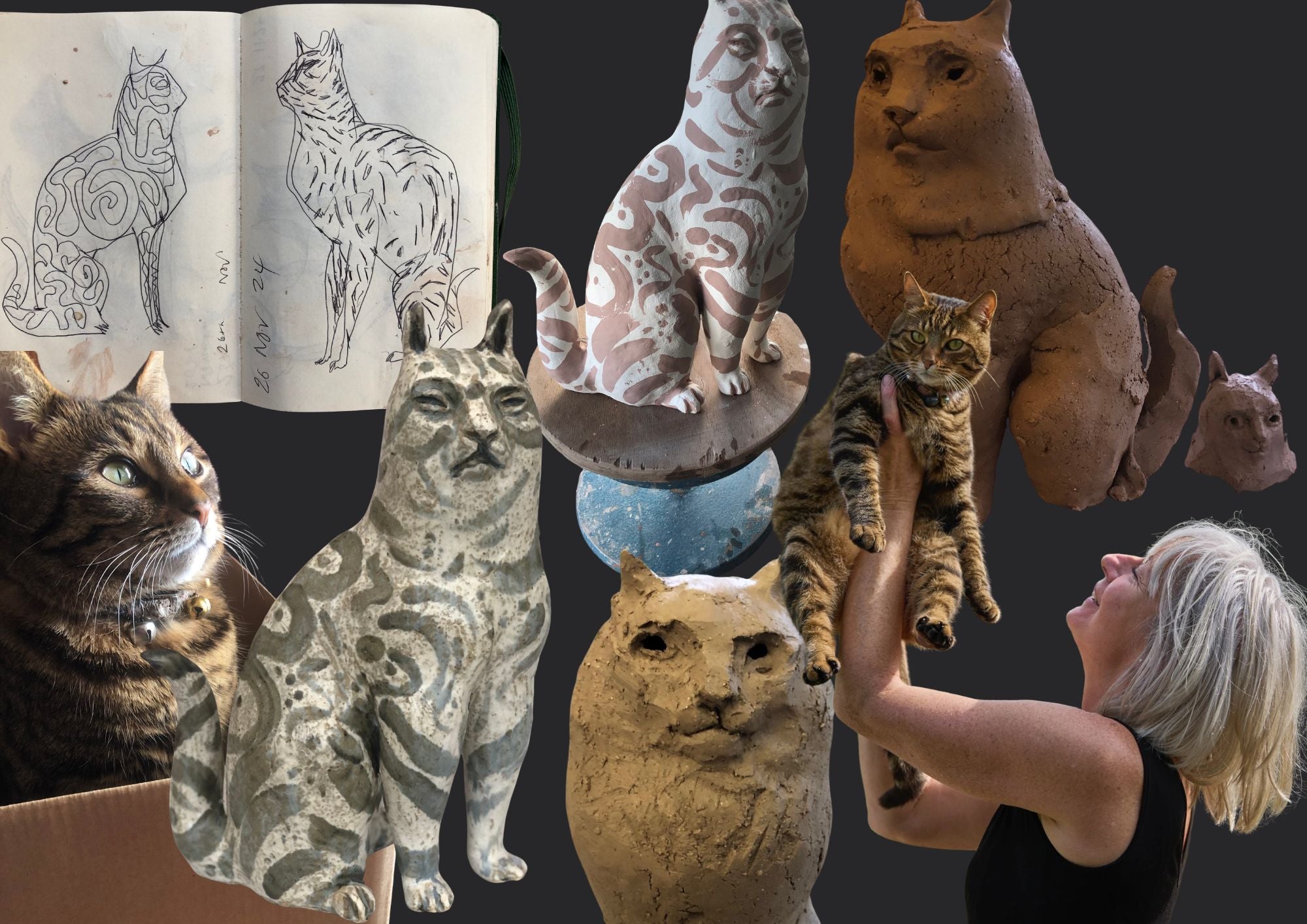
Anyone who has ever lived with a cat knows the look: that slow, appraising gaze that suggests you have been assessed, found adequate, and may now be permitted to continue what you were doing. It is a look that ceramic artist Susan Halls captures brilliantly. Not through exaggeration, but through a kind of sculptural understatement that somehow makes it even more sublime.

For over four decades, Halls has worked with animals in clay; pigs, horses, hares (to name a few of her menagerie), observing each with a careful eye for form and character. But it is her recent turn to the domestic cat that piqued my curiosity. Her feline forms are knowing without being cute, familiar without being cosy, and possessed of exactly the sort of quiet superiority that any cat owner will recognise immediately.
I first discovered her work on Instagram and was completely captivated. Each piece manages to be both an individual cat and every cat you have ever met, which is a difficult trick to pull off in any medium, let alone fired clay. There is something in them that bypasses description and goes straight to feeling — a true cattiness that no amount of sentimentality could achieve.
When we spoke recently, Halls told me how a tabby called Mussels, acquired during the peculiar stillness of COVID, wandered into her studio and opened up a subject she had cheerfully ignored for decades — and why, even now, she has absolutely no interest in making cats look adorable.
“The moment you introduce eyes, you inevitably introduce personality. The question is what sort of personality you want.”
Sonja: After more than forty years sculpting animals, your recent work has increasingly explored cats. What led to that shift?
Susan: For many years, I had absolutely no interest in cats as a subject. When I was living in the United States, I was there for about twenty years, I had a friend who ran a gallery and was completely cat-mad. She used to say to me constantly, “You should do cats. Your cats would be amazing.”
But at the time, I didn’t even have a cat. I was living with a dog, and I just couldn’t imagine a way into cat imagery. I’d grown up with cats, but I’d always wanted dogs, so once I had the choice, I kept dogs instead.
Then, during COVID, things shifted. My dog had died a couple of years earlier, and suddenly I had no animals in my life at all. I’d always had a small menagerie (rabbits, guinea pigs, even rats), so the silence felt quite strange.
My partner and I would go to pubs where you’d sometimes see cats wandering around the barstools, and I found myself sketching them. That was probably the first spark. I wanted a bog standard tabby tomcat, a real little stripey tiger. Eventually, we found a litter in Devon and that’s when Mussels came into our lives. The minute he came, I could see the possibilities. I got so excited about the patterns and the colours of his coat and how those might translate into clay and glaze.
Sonja: What’s Mussels like?
Susan: He’s incredibly devoted. He follows me everywhere and likes to be near me, but he’s not really a lap cat. He chooses when to sit on you, and that’s quite infrequent. Mostly, he just wants to be present. If I’m in the studio, he’s there. If I’m in the garden, he comes out. He’s one of those real companion cats, and I’ve never had that in a cat before.

Sonja: Your work has sometimes been described as unsentimental. Is that something you recognise?
Susan: Yes, I think so. I really do pursue making work that isn’t cute or cuddly, and hopefully not anthropomorphic either. Of course, it sometimes slips in. It’s very difficult to avoid entirely. But I try not to sentimentalise the animal.
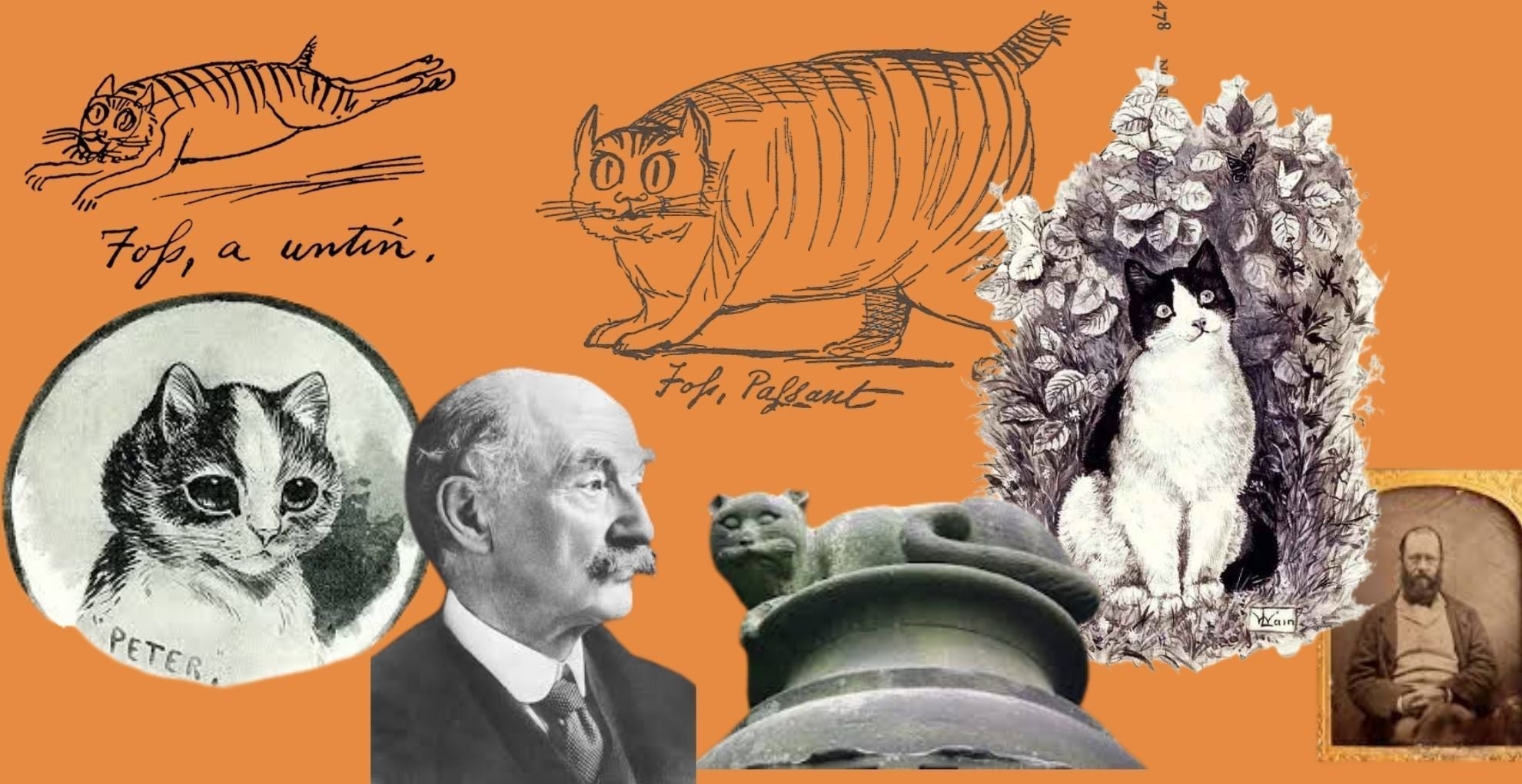
Sonja: One of the great precedents for cat imagery in art is Louis Wain, whose cats are famously anthropomorphic.
Susan: Yes, and I do admire those works. There’s a sort of Victorian charm to them. But when you really look at them, they’re not entirely sweet. There’s something quite electric about them, a kind of tension. The cats often look as though they’re plotting something.
I think that’s what I respond to. They have presence and personality. They’re not just decorative cats doing something cute.
Sonja: Cats are such familiar domestic animals, but they’re also incredibly complex creatures.
Susan: Exactly. I don’t want them to look wild. They are domestic cats. But I also don’t want them to be flooded with personality or expression.
The real challenge comes with the face. The tiniest adjustment, like the angle of the eyes or the slight turn at the corner of the mouth, can suddenly create a completely different character. The moment you introduce eyes, you inevitably introduce personality. The question is what sort of personality you want.
Sonja: Something slightly ambiguous, perhaps.
Susan: Yes. Slightly ambiguous. Perhaps slightly menacing, a hint of danger.
"When I’m left to my own devices, I’m much more interested in cats that feel just a little uncomfortable. Not aggressive, but not entirely reassuring either."
Sonja: That feels very true to the nature of cats themselves.
Susan: Exactly. Mussels can be incredibly affectionate, purring and curling up beside you, but then you see him hunting, and you remember there’s a small tiger there.
When he brings a bird into the house at two o’clock in the morning, I’m absolutely furious with him. But you can’t deny the nature of the animal. A friend once said to me, “You can’t punish a cat for being a cat.” And it’s true. They carry that wildness with them, even in the most domestic setting.
Sonja: Could you talk about how you approach the making process?
Susan: I’ll have been thinking about what I’m making long before I start. That’s where the drawing comes in, just putting ideas down on paper, shedding them like fur, because they come so quickly. The sketches are very loose. They’re just a guide.

At the same time, I’m thinking about glazes, doing tests, looking at results. I formulate my own glazes and I’m always trying to change them, develop the colours. So all of that is happening in parallel.
Once I start making, I really do one piece after another after another. I start with the body shape, then put the legs on so that it can stand up, and work towards the head. Sometimes it’s the smallest details that are the most problematic. One tiny change around the eyelid can alter the whole expression. I’ll overwork the details and have to take it all off and start again.
Sonja: So you always begin with a drawing?
Susan: Always. Without the sketch, I find it very hard to work. I keep changing my mind if I’m working from something locked in my head. The drawing is like a map. When I start making, I really need the piece to work. I hate it when things fail. Drawing is like backup. It puts me on the right track.
I draw far more cats than I ever make. In a sense, I’m sorting out a hierarchy: who’s the most worthy. I’ll look at a sketch and think, no, not good enough, or I’ll take a bit from one drawing and carry it into the next.
“It’s almost like a vase shape. A vase with a head.”
Sonja: The seated cat form has become quite central to your work.
Susan: I love the seated form. It’s so classic. It has all those Egyptian references, but also the early ceramic sculpture, really ornaments, that came out of Stoke-on-Trent and the London potteries in the eighteenth and nineteenth centuries. The little mantle cats. Then there are the sphinx cats, which I absolutely love, and all that heraldic imagery. Lions, griffins, flanking a mantelpiece. It’s essentially the same pose. It’s commanding.
And it’s exciting as a potter, because the form itself is almost like a vase shape. A vase with a head, in a sense. A lovely vertical form.

Sonja: The glaze must be nerve-racking, though. You spend all that time on the form and then risk ruining it in the kiln.
Susan: The kiln has the deciding say. But sometimes things are unexpected in a good way. You get something better than you were expecting.
I like it when it’s a first-time success. But I’m always changing things, trying two colours together, or applying the glaze a bit thicker at the top. If I always used the same glazes, the same patterns, the same firing procedure, everything would come out fine. But I always want to keep playing.

“I want to prove to myself that I’m not relying on the patterns to make the piece.”
Sonja: Your tabby work is so much about pattern and colour. What happens when you work with a single-coloured cat?
Susan: It’s more difficult, honestly. I did a commission last summer for a short-haired breed, a dark browny-black cat with gold eyes. The single colour was really unrewarding. Even though I found a glaze with some interest in it, it just didn’t work as well for me.
I did make a black cat for myself, not a commission, which was much more successful. It was quite textured, and I left colour out of the eyes entirely. I think it’s a big mistake to do a single glaze with a coloured eye. It just disrupts the whole thing.
What I really want to explore is cats that aren’t striped but have an island of colour, a saddle perhaps, or a calico pattern. Something more subtle, where the pattern doesn’t dominate. I want to prove to myself that I’m not relying on the patterns to make the piece.
Sonja: Does that make commissions tricky when someone comes to you wanting a specific cat?
Susan: It can. I turned a woman down last year who wanted two very large mantle cats. She started to get very prescriptive, and I just thought, it’s not going to work for me. If someone commissions me, they’ve got to let me use my own voice and do an interpretation. I’m not doing a portrait.
Pet portraiture is really difficult for me. If I try, I don’t think you’re getting the best out of me. There are plenty of people who do that kind of work better than I would. When I try, it results in a very dead, uninspired piece. It’s just not where my strengths are.
Sonja: After all these years, does it surprise you that cats have become such a central part of your work?
Susan: Completely. If you’d told me ten years ago that I’d be spending most of my time sculpting cats, I’d have laughed at you. I resisted them for decades. But now I feel like I’ve only just started. There are so many forms I haven’t tried, so many glazes I haven’t tested. The seated cats have been my focus for a long time, but I want standing cats, cats in movement, cats in different positions entirely. I’m nowhere near finished.
Sonja: And after the cats?
Susan: Cows, possibly. I’ve been drawing them for two years, trying to find my way in. But that’s how it always starts: a long stretch of looking and sketching before I can see how to make it mine. The cats were exactly the same. Years of ignoring them, and then one tabby walks into your studio and the whole thing opens up.
Sonja: That does seem to be a pattern. The subject finds you rather than the other way around.
Susan: I think that’s right. You can’t force it. You have to live alongside something before you can really make it. Mussels taught me that. He didn’t arrive as a subject. He arrived as a cat. The work came afterwards, once I’d watched him long enough to understand what I was actually looking at.
Susan Halls’ next body of cat work will be shown at Among the Pines Gallery in Bath from May 6th – June 2nd 2026. Her work can also be found on her website and on Instagram.
Watch the full interview on Youtube. CLICK HERE
Share:
Cats in Memoriam - Remembering Beloved Cats through History